We are in the midst of an effort to explore what the new technologies enabled by powerful computing and reliable long-distance connection will mean to higher education. (There is, of course, a parallel effort in K-12, but that’s another topic.)

A new entrant is poised to make a bid, and it’s worth some study.

The Minerva Project was initiated by Ben Nelson, the man behind Snapfish (a photo website). His vision is of a university that offers an “uniquely rigorous and challenging university education." (At a price, we might add, that is a relative bargain--reportedly, the target cost is something like half of what the Ivys charge).

The idea is that classes will be delivered via video, and students will then engage in discussion and debate. Importantly, and in pointed contrast to MOOCs, class size will be limited to 25.
Picture
Because the university is virtual, students can live anywhere, but they will be encouraged to live in a different world city each semester, perhaps living together to gain some of the face-to-face interactions that many observers consider a significant advantage of bricks-and-mortar university life.

The curriculum will not rest on traditional academic subject divisions (some English, some math, some science) but rather on four essential skills: critical thinking, use of data, understanding complex systems, and effective communication. If that sounds squishy, be forewarned that the courses are planned to be demanding, and students who do not perform well will (gasp) fail the course.

Minerva is trying something quite different than other online higher ed options. Online universities exist, but their appeal has been their low price and low academic standards and, to a lesser extent, flexibility in scheduling. They claim to offer a degree that is comparable to a traditional degree, though few believe that they do.

It’s still not completely obvious how MOOCs (as implemented in Coursera and edX) will evolve, but no one thinks the long-term purpose is to give away courses. The interpretation I hear most often is that they will not seek replace standard degrees, but will offer more of an a la carte education; you take, say, 12 engineering courses (earning certificates showing that you’ve done the work) in the hopes that the reputation of the participating institutions will be enough to persuade an employer that passing the courses means you’ve got the chops for a job—and you’ve paid just a tiny fraction of what a traditional engineering degree would have cost.

Minerva seeks a third way. It promises an elite education, comparable to the most selective schools in the US. They are gambling that this option will appeal to students who were qualified to attend a big-name university, but didn’t get in.

It’s a darn good bet that there are plenty of frustrated students who thought they had the record for admission to Big-Name U; these places reject 75% or more of their applicants.

It’s no accident that the Minerva website notes that admissions decisions will disregard “lineage, state or country of origin, athletic prowess, or ability to donate.” In other words, "if you fear that you will be jostled by affirmative action targets, athletic admissions, legacies, etc., apply here."

Picture
The question is whether these students will see Minerva as a viable alternative to traditional schools.  

Naturally, that will depend on the quality of the courses and the curriculum. Minerva has not hired any faculty yet, but Nelson has some high profile members on his board (Larry Summers, Bob Kerrey) and they just hired Steve Kosslyn as the founding Dean of the College. Kosslyn has been a Dean at Harvard and was most recently Director of the Center for Advanced Study of Behavioral Sciences at Stanford. To lure someone that capable to devote all of his energies to Minerva bodes well for the project.

We may be seeing the first of new wave of elite colleges. In the colonial era and following, this country saw elite colleges founded to train clergy (Harvard, Yale, Princeton). Better than a century later there was another spate, as wealthy industrialists founded new schools or heavily endowed existing ones (U of Chicago, Stanford, Vanderbilt).

There may well be room for a new model of elite higher education, and Minerva, as the first one out of the gate, holds a significant advantage.  

Note:  Thanks to Chris Chabris, whose Facebook post made me aware of Minerva.


Is technology changing how students learn, that is, the workings of the brain?

An article in today's New York Times reports that most teachers think the answer is "yes," and this development is not positive.

The article reports the results of two surveys of teachers, one conducted by the Pew Internet Project, and the other by Common Sense Media. Both report that teachers believe that students' use of digital technology adversely affects their attention spans and makes them less likely to stick with challenging tasks.

In interviews, many teachers report feeling that they have to work harder than they used to in order to keep students engaged.
As the article notes, there have not been any long-term studies that show whether student attention span has been affected by digital media.

Still, a lot of psychologists are actually skeptical that digital media are likely to fundamentally change the fundamentals of human cognition.

Steven Pinker has written "Electronic media aren't going to revamp the brain's mechanisms of information processing." I made the same argument here.

The basic architecture is likely to be relatively fixed, and in the absence of extreme deprivation, will develop fairly predictably. Sure, it is shaped by experience but those changes will just tune to experience what's already there--it might change the dimensions of the rooms, without altering the fundamental floor plan, so to speak.

Does that view conflict with teacher's impressions? Not necessarily.

When we talk about a student's attention span, I suspect we're really talking about a particular type of attention. It's not their overall ability to pay attention: kids today can, I think, get lost for hours in a movie or a book or a game just as readily as their parents did. Rather, the seemingly shorter attention span is their ability to maintain attention on a task that is not very interesting to them.

But even within that situation, I suspect that there are two factors at work: one is the raw capacity to direct one's attention. The second is the willingness to do so.

I doubt that technology affects the first, but I'm ready to believe that it affects the second.

Directing attention--forcing yourself to think about something you'd rather not think about--is effortful, even mildly aversive. Why would you do it? There are lots of possible reasons. Among them would be previous experiences leading you to believe that such sustained attention leads to a payoff.

In other words, if you've grown up in circumstances where very little effort  usually led to something that was stimulating and interesting, then you likely have an expectation that that's the nature of the world: I do just a little something, and I get a big payoff. (And the payoff is probably immediate.)

The process by which children learn to expect a lot of cool stuff to happen based on minimal effort may start early.

When a toddler is given a toy that puts on a dazzling display of light and sound when a button is pushed, we might be teaching him this lesson.
In contrast, the toddler who gets a set of blocks has to put a heck of a lot more effort (and sustained attention) into getting the toy to do something interesting--build a tower, for example, that she can send crashing down.

It's hard for me to believe that something as fundamental to cognition as the ability to pay attention can moved around a whole lot. It's much easier for me to accept that one's beliefs--beliefs about what is worthy of my attention, beliefs about how much effort I should dispense to tasks--can be moved around, because beliefs are a product of experience.

I actually think that much of what I've written here was implicit in some of the teachers' comments--the emphasis on immediacy, for example--but it's worth making it explicit.


The importance of a good relationship between teacher and student is no surprise. More surprising is that the "human touch" is so powerful it can improve computer-based learning.

In a series of ingenious yet simple experiments, Rich Mayer and Scott DaPra showed that students learn better from an onscreen slide show when it is accompanied by an onscreen avatar that uses social cues.
Eighty-eight college students watched a 4-minute Powerpoint slide show that explained how a solar cell converts sunlight to electricity. It  consisted of 11 slides and a voice-over explanation.

Some subjects saw an avatar which used a full compliment of social cues (gesturing, changing posture, facial expression, changes in eye gaze, and lip movements synchronized to speech) which were meant to direct student attention to relevant features of the slide show.

Other subjects saw an avatar that maintained the same posture, maintained eye gaze straight ahead, and did not move (except for lip movements synchronized to speech).

A third group saw no avatar at all, but just saw the slides and listened to the narration.

All subjects were later tested with fact-based recall questions and transfer questions (e.g. "how could you increase the electrical output of a solar power?") meant to test subjects ability to apply their knowledge to new situations.

There was no difference among the three groups on the retention test, but there was a sizable advantage (d = .90) for the high embodiment subjects on the transfer test. (The low-embodiment and no-avatar groups did not differ.)

A second experiment showed that the effect was only obtained when a human voice was used; the avatar did not boost learning when synchronized to a machine voice.

The experimenters emphasized the social aspect of the situation to learning; students process the slideshow differently because the avatar is "human enough" for them to treat it prime interaction like those learners would use with a real person. This interpretation seems especially plausible in light of the second experiment; all of the more cognitive cues (e.g., the shifts in the avatar's eye gaze prompting shifts in learner's attention) were still present in the machine-voice condition, yet there was no advantage to learners.

There is something special about learning from another person. Surprisingly, that other person can be an avatar.

Mayer, R. E. & DaPra, C. S. (2012). An embodiment effect in computer-based learning with animated pedagogical agents. Journal of Experimental Psychology: Applied, 18,  239-252.
 
 
A lot of people have been tweeting or posting to Facebook a link to a graph which was posted to the Atlantic Monthly website on April 6, with this provocative headline:
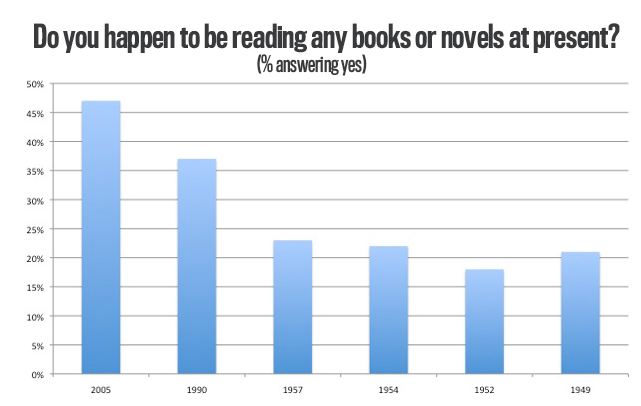
And here's the chart you are urged to show, derived from Gallup poll numbers over the years.
We're invited to conclude that because the percentage of readers increased after the advent of the Internet, the Internet did not have a negative impact on book reading.

All of the postings I've seen have apparently taken this conclusion at face value, so it seems like it's worth going through why this conclusion is not justified.

First, lots of stuff happened between 1949 and 2005. For example, household income increased for middle- and high-income families. It could be that the internet has negatively affected book reading, but a number of other factors have increased it, so overall we see an increase. The idea that other factors are having a big impact on reading seems legitimate, given the big increase in reading from 1957 to 1990, a year in which very few people had internet access. So perhaps those factors are continuing to boost reading, despite the negative impact of the internet.

The type of analysis we're being asked to perform implicitly is a variety of time series analysis. It's useful in situations where one can't conduct an experiment with a control group. For example, I might track classroom behavior daily for one month using a scale that runs from 1-10. I find that it ranges from 4 to 6 every day. The teacher implements a new classroom management scheme, and from that day forward, classroom behavior ranges from 7 to 9 every day.

Interpreting the new classroom management scheme as the cause of the change is still not certain--some outside-of-class-factor could have just happened to have occurred on that same day that prompted the change in classroom behavior. But the fact that the change in behavior happened over such a narrow time window makes us more confident that such a coincidence is unlikely.

And of course it helps my confidence that it's the same class. In the chart above, we're looking at events that happened over years, with different people who we hope had similar characteristics.

To really get at the effect of the internet on reading habits, you need more finely controlled data. A number of studies were done in the 1950s, examining the effect of television on reading habits. The best of these (see Coffin, 1955) measured reading habits in a city that did not have a television station but was poised to get one, and then measured reading habit again after people in the city had access to television. (The results showed an impact on reading, especially light fiction. Newspaper reading was mostly unaffected, as television news was still in its infancy. Radio listening took a big hit.)

Second, we might note that the most recent year on the chart is 2005. According to the Pew Internet and American Life Project, only 55% of Americans had internet access at that point, and only 30% had broadband. So perhaps the negative impact wouldn't be observed until more people had internet access.

This brings us to more serious studies of whether use of the Internet displaces other activities. The studies I know of (e.g., Robinson, 2010) conclude that Internet use does not displace other activities, but rather enhances them. The data are actually a bit weird--IT use is associated with more of everything: more leisure reading, more newspaper reading, more visits to museums, playing music, volunteering, and participating in sports.

The obvious explanation would be that heavy IT users have higher incomes and more leisure time, but the relationships held after the author controlled for education, age, race, gender, and income--though most of these effects were much attenuated.

This research is really just getting going, and I don't think we're very close to understanding problem.

In sum, the question of what people do with their leisure time and how one activity influences another is complicated. One chart will not settle it.


Coffin, T. E. (1955) Television's impact on society. American Psychologist, 10, 630-641.
Robinson, J. P. (2011) Arts and leisure participation among IT users: Further evidence of time enhancement over time displacement. Social Science Computer Review, 29,  470-480.
 
 
David Daniel and I have a letter in latest issue of Science. It's behind a paywall, so I thought I'd provide a summary of the substance.

David and I note that there is, in some quarters, a rush to replace conventional paper textbooks with electronic textbooks. It is especially noteworthy that members of the Obama administration are eager to speed this transition. (See this report.)

On the face of it, this transition is obvious: most people seem to like reading on their Nook, Kindle or iPad--certainly sales of the devices and of ebooks are booming. And electronic textbooks offer obvious advantages that traditional textbooks don't, most notably easy updates, and embedded features such as hyperlinks, video, and collaboration software.

But David and I urged more caution.

We should note that there are not many studies out there regarding the use of electronic textbooks, but those that exist show mixed results. A consistent finding is that, given the choice, students prefer traditional textbooks. That's true regardless of their experience with ebooks, so it's not because students are unfamiliar with them (Woody, Daniel & Baker, 2010). Further, some data indicate that reading electronic textbooks, although it leads to comparable comprehension, takes longer (e.g., Dillon, 1992; Woody et al, 2010).

Why don't students like electronic textbooks if they like ebooks? The two differ. Ebooks typically often have a narrative structure,  they are usually pretty easy to read, and we read them for pleasure. Textbooks in contrast, have a hierarchical structure, the material is difficult and unfamiliar, and we read them for learning and retention. Students likely interact with textbooks differently than books they read for pleasure.

That may be why the data for electronic books are more promising for early grades. Elementary reading books tend of have a narrative structure, and students are not asked to study from the books as older kids are.

Further, many publishers are not showing a lot of foresight in how they integrate video and other features in the electronic textbooks. A decade of research (much of it by Rich Mayer and his collaborators and students) show that multimedia learning is more complex than one would think. Videos, illustrative simulations, hyperlinked definitions--all these can aid comprehension OR hurt comprehension, depending on sometimes subtle differences in how they are placed in the text, the specifics of the visuals, the individual abilities of readers, and so on.

None of this is to say that electronic textbooks are a bad thing, or indeed to deny that they ought to replace traditional textbooks. But two points ought to be kept in mind.
(1) The great success of ebooks as simply the porting over of traditional books into another format may not translate to electronic textbooks. Textbooks have different content, different structure, and they are read for different purposes.
(2) Electronic textbooks stand a much higher chance of success if publishers will exploit the rich research literature on multimedia learning, but most are not doing so.

For these two reasons, it's too early to pick the flag and shout "Hurrah!" on electronic textbooks.


A. Dillon, Ergonomics 35, 1297 (1992).
W. D. Woody, D. B. Daniel, C. Baker , Comput. Educ. 55, 945 (2010)
 
 
A new review takes on the question "Does video gaming improve academic achievement?"

To cut to the chase, the authors conclude that the evidence for benefit is slim: they conclude that there is some reason to think that video games can boost learning in history, language acquisition, and physical education (in the case of exergames) but no evidence that gaming improves math and science.

It's notable that the authors excluded simulations from the analysis--simulations might prove particularly effective for science and math. But the authors wanted to examine gaming in particular.

Lest the reader get the impression that the authors might have started this review with the intention of trashing gaming, they authors describe themselves as "both educators and gamers (not necessarily in that order)" and even manage to throw a gamer's inside joke in the article's title: "Our princess is in another castle." (If this doesn't ring a bell, an explanation is here.)

And they did try to cast a wide net to capture positive effects of gaming. They did not limit their analysis to random-control trials, but included qualitative research as well. They considered outcome measures not just of improved content knowledge (history, math, etc.) but also claims that gaming might build teams or collaborative skills, or that gaming could build motivation to do other schoolwork. Still, the most notable thing about the review is the paucity of studies: just 39 went into the review, even though educational gaming has been around for a generation.

Making generalizations about the educational value of gaming is difficult because games are never played the same way twice. There's inherent noise in the experimental treatment. That makes the need for systematicity in the experimental literature all the more important. Yet the existing studies monitor different player activities, assess different learning outcomes, and, of course, test different games with different features.

The authors draw this rather wistful conclusion: “The inconclusive nature of game-based learning research seems to only hint at the value of games as educational tools.”

I agree. Although there's limited evidence for the usefulness of gaming, it's far too early to conclude that gaming can't be of educational value. But for researchers to prove that--and more important, to identify the features of gaming that promote learning and maintain the gaming experience--will take a significant shift in the research effort, away from a piecemeal "do kids learn from this game?" to a more systematic, and yes, reductive analysis of gaming.

Young, M. F. et al. (2012). Our princess is in another castle: A review of trends in serious gaming for education. Review of Educational Research, 82, 61-89.
 
 
Today's New York Times has an article speculating that when you read on an ereader or tablet, your attention is likely to be diverted to other applications.

If you hit a dull patch in the book, can you resist the pull of YouTube, Twitter, or your email? Even if you're engaged in the book, Google may beckon to clarify a point in the book ("Essex? Where's that?") and next thing you know, 25 minutes have elapsed in surfing. Perhaps interesting, perhaps productive, but not what you sat down intending to do.

Many people I've spoken with have the impression that this sort of distraction is predictable, and that it is a greater problem when reading on a tablet computer, even compared to reading a print book with a computer nearby.

The data on this question are still thin, but I do know of one relevant study (Woody et al, 2011). Nearly 300 college students took part, each reading a chapter from an introductory psychology textbook in one of five formats: print textbook, printed text pages, printed manuscript in MS Word, electronic pdf file, or electronic textbook. Some students read in a laboratory, some at home, and everyone took a quiz on the chapter material after reading it.

The results showed that media format did not affect quiz grades. But students who read electronic media versions were more likely to respond to instant messages and email while reading, and were more likely to use social networking sites (Facebook/Myspace) while reading.

It's only one experiment, but this feels like an instance where the intuitions of the majority of people will end up according with data. Whether the extra level of distraction is really a problem remains to be seen; and it may well be that users (or software designers) come up with strategies to solve the problem, if it proves significant.

Woody, W. D., Daniel, D. B., & Stewart, J. M. (2011).  Students’ Preferences and Performance  Using E-Textbooks and Print Textbooks.  In F. Columbus (Ed.), Computers in Education.  New York: Nova Publishing.


     It's a funny thing about the use of new technologies in schools: it's not only seen as inevitable, it's often described as necessary because today's students are digital natives.
     But for at least some technologies, the evidence supporting that contention is weak.
     An article in Computers & Education by Woody, Daniel, & Baker (2010) replicated other studies in showing that college students preferred studying from traditional textbooks rather than etextbooks, and also reported no correlation between previous experience with ebooks and how much students liked etextbooks.
     Some technology boosters have suggested that previous findings of student indifference to etextbooks is due to their novelty--once students get used to them, the argument goes, they will like them. Woody et al. suggest that their finding casts doubt on this explanation.

Woody, W. D., Daniel, D. B. & Baker, C. A. (2010). E-books or textbooks: Students prefer textbooks. Computers & Education, 55, 945-948.