Am I stupid if I can't turn on my stove? The picture below (or one very similar) appears in most textbooks on human factors psychology.
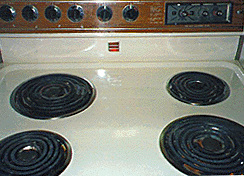
The arrangement of controls is spatially incompatible with the arrangement of stove elements, so if I want to turn on the back left element, I may very well turn on the front left one.
What's notable is that this stove likely came with an instruction book, describing which knob goes with which burner.
But something about that feels wrong. It feels like the designer of the stove should have known how my mind works, and taken that into account, rather than shrugging and saying "well, it's in the manual. It's not my fault if you don't read the manual."
The stove reminds me of value-added measures of teacher effectiveness.
Even the staunchest boosters of value-added measures agree that they should not be the whole story, that there should be multiple measures of teacher effectiveness. But I'm afraid that asking people to remember that fact is a little like asking people to remember which knob goes with which burner on their stove. It's not that people can't do it, but you are swimming upstream of the mind's biases.
To be clear, I don't think that there are data to prove this contention, but let me describe why I'm guessing it's true.
We're talking about a case of missing information: you tell people: "Teacher Smith's value-added score is X. By the way, value-added scores are incomplete as a measure of teacher effectiveness"
How do people interpret information that they know to be incomplete? It varies with the situation. Sometimes they assume the missing information is positive. ("I haven't heard that the roads are closed, so I guess all's well.") Sometimes they assume missing information is negative ("He left 'prior experience' blank, so I guess he doesn't have any.")
And sometimes missing information is forgotten or discounted. My guess--and I emphasize that it's a guess--is that will be the case here. I make this guess in part by analogy to the evaluation of college applicants.
A student's high school record has lots of "soft" components, the values of which are tricky to evaluate: participation in sports and clubs, leadership positions, recommendations from teachers. . .. even a student's grade point average must be evaluated in light of the difficulty of the courses taken and the competitiveness of the high school.
But then there's the SAT. It has the gloss of being numeric, and it is easy to make comparisons across students. Make no mistake, I believe that the SAT does what it's supposed to do--predict success in the freshman year of college. But it's often interpreted to be much more meaningful than that. That's the problem.
I'm afraid that value-added measures will have the same problem. They are produced via a fancy formula, they make it simple to make comparisons, and they are numeric, which can lead one to conclude that they are more precise than they really are. And at this point, we don't even have any of the other "soft" measures to round out the picture of teacher effectiveness.
I don't think value-added measures are meaningless. But handing people value-added measures with the bland warning "these are incomplete" is like giving me a stove with a bad mapping plus an instruction booklet.
The solution to the stove problem is straightforward
What's notable is that this stove likely came with an instruction book, describing which knob goes with which burner.
But something about that feels wrong. It feels like the designer of the stove should have known how my mind works, and taken that into account, rather than shrugging and saying "well, it's in the manual. It's not my fault if you don't read the manual."
The stove reminds me of value-added measures of teacher effectiveness.
Even the staunchest boosters of value-added measures agree that they should not be the whole story, that there should be multiple measures of teacher effectiveness. But I'm afraid that asking people to remember that fact is a little like asking people to remember which knob goes with which burner on their stove. It's not that people can't do it, but you are swimming upstream of the mind's biases.
To be clear, I don't think that there are data to prove this contention, but let me describe why I'm guessing it's true.
We're talking about a case of missing information: you tell people: "Teacher Smith's value-added score is X. By the way, value-added scores are incomplete as a measure of teacher effectiveness"
How do people interpret information that they know to be incomplete? It varies with the situation. Sometimes they assume the missing information is positive. ("I haven't heard that the roads are closed, so I guess all's well.") Sometimes they assume missing information is negative ("He left 'prior experience' blank, so I guess he doesn't have any.")
And sometimes missing information is forgotten or discounted. My guess--and I emphasize that it's a guess--is that will be the case here. I make this guess in part by analogy to the evaluation of college applicants.
A student's high school record has lots of "soft" components, the values of which are tricky to evaluate: participation in sports and clubs, leadership positions, recommendations from teachers. . .. even a student's grade point average must be evaluated in light of the difficulty of the courses taken and the competitiveness of the high school.
But then there's the SAT. It has the gloss of being numeric, and it is easy to make comparisons across students. Make no mistake, I believe that the SAT does what it's supposed to do--predict success in the freshman year of college. But it's often interpreted to be much more meaningful than that. That's the problem.
I'm afraid that value-added measures will have the same problem. They are produced via a fancy formula, they make it simple to make comparisons, and they are numeric, which can lead one to conclude that they are more precise than they really are. And at this point, we don't even have any of the other "soft" measures to round out the picture of teacher effectiveness.
I don't think value-added measures are meaningless. But handing people value-added measures with the bland warning "these are incomplete" is like giving me a stove with a bad mapping plus an instruction booklet.
The solution to the stove problem is straightforward

The solution to teacher evaluation is not straightforward, and I won't attempt to resolve it in a blog posting.
My purpose here is simply to highlight the problem in publishing value-added data for individual teachers, with the caveat "these measures are incomplete." I predict that caveat will go unnoticed or be forgotten.
My purpose here is simply to highlight the problem in publishing value-added data for individual teachers, with the caveat "these measures are incomplete." I predict that caveat will go unnoticed or be forgotten.
 RSS Feed