Every year I teach an introductory course on cognitive psychology to about 350 students. Every year I ask my students how they study and I find that they are much like students at Purdue, Washington University in St. Louis, UCLA, and Kent State--universities at which surveys have been conducted on student study strategies.

Like students at those schools, my students tend to take notes in class, color the readings with a highlighter, and later reread the notes and the highlighted bits of the text.

This Table show the results of a study by Jeff Karpicke and his colleagues (2009)  on the study strategies of students at Washington University in St. Louis. (For other studies leading to similar conclusions see Hartwig & Dunlosky, 2012; Kornell & Bjork, 2007).
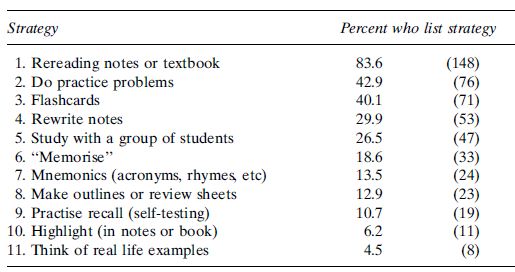
Rereading is a terribly ineffective strategy. The best strategy--by far--is to self-test--which is the 9th most popular strategy out of 11 in this study.  Self-testing leads to better memory even compared to concept mapping (Karpicke & Blunt, 2011).

The table shows that students rarely self-test as a learning strategy. Other data show that they more often self-test as a check to be sure that they have studied enough.

There is much discussion these days of how much time students ought to spend studying text for later tests of factual recall. Whatever  your answer to this question, if students are going to do it, we might as well give them the tools to do a good job.

This article on the website of the American Psychological Association is a good start.


Hartwig, M. K. & Dunlosky, J. (2012). Study strategies of college students: Are self-testing and scheduling related to achievement? Psychonomic Bulletin & Review, 19,  126-134.

Karpicke, J. D. & Blunt, J. R. (2011). Retrieval practice produces more learning than elaborative studying with concept mapping. Science, 331, 772-775.

Karpicke, J. D., Butler, A. C., & Roediger, H. L., III. (2009). Metacognitive strategies in student learning: Do students practice retrieval when they study on their own? Memory, 17, 471–479.

Kornell, N., & Bjork, R. A. (2007). The promise and perils of self regulated study. Psychonomic Bulletin & Review, 14, 219–224.


Comments

Genevieve
03/26/2012 4:38pm

I am a returning college student. The first time around I didn't study much and what I did was mostly reading notes and some practice problems.
This time around my text books have come with online access to study areas/online text. It has really changed my study habits (though I have also changed my study habits because of following blogs like this). The study areas have chapter quizes and tests. It is much easier to self-test. I also can get immediate feedback, I know right away if I am wrong.

09/05/2012 6:29am

i like this blog!thank u!!

Bonnie Daley
03/26/2012 5:10pm

I teach eighth grade science and am forced to give quite a few tests since my students are tested in science on their standardized test at the end of the year. I've tried every study method to help them do better. This is a great list and I think it helps to give students a choice and class time to practice their study habits. Many of eighth graders simply won't take time outside of class. I do have a few very motivated students who use some of these techniques on their own.

03/27/2012 3:34pm

We should be using formative assessments regularly or provide students with formative assessment tools (like self-tests). I often ask my students to create surveys or formative interactive quizzes using Hot Potatoes modules so they understand the strategies behind and application of the concepts. As most educators know, knowledge recall is the most basic of cognitive levels. Educators should apply higher-level activities.

Bonnie Daley
03/28/2012 2:32pm

Thanks for this tip Leanna. Yes, formative assessments are helpful, the Paige, Keely books are used frequently at my school.

Gary
03/27/2012 9:23pm

I give students ungraded quizzes at the opening and at the end of my college classes. I read their responses and give them feedback by the next class. This strategy tells me IMMEDIATELY what the next class needs to concentrate on. Thanks Dan for the gloss and links.

03/28/2012 1:53pm

Wet noodle time for not reading Karpicke and Blunt (2011) carefully. What you (and many newspaper reporters) described as "self test" is clearly described as "retrieval practice" by the authors -- i.e., after reading the material, students were shown a blank text box and asked to write EVERYTHING they remembered about the reading. That's not a self-test, and what it suggests is that paraphrasing practice is more effective than rereading or concept mapping. "Self test" was not a condition in the two experiments reported.

03/28/2012 2:15pm

@Sherman noodle accepted, but for different reasons than you suggest. "Retrieval practice" is a term that Roediger started using because he thought that "self test" evokes the idea of formal testing, whereas data from his lab (and others) indicates that it's trying to retrieve memories that produces the boost to learning. but you're right, I should have used the term the researchers used!

03/28/2012 2:17pm

And Roediger is right! The news reporting of the study clearly implied this was about formal testing, and the earlier comments on this entry strongly suggest my fellow readers of your blog interpreted the term in the same way.

03/28/2012 2:24pm

@Sherman Ah, got you now. Everyone, SHERMAN IS RIGHT--if you understood this point, but it was despite my blog entry, not because of it. Thanks for the clarification. Doesn't mean, of course, that Genevieve, Bonnie, Leanna, and Gary's methods aren't working--just means that there could be other methods that would work too!

Bonnie Daley
03/28/2012 2:39pm

Yes, paraphrasing is great when you have students who are articulate. I think it does not work as well with English language learners. They have to look up every word and simply cannot put it into their own words because they don't have the language! Especially with topics such as physics, you may not want students to put it into their own words; sometimes the gray areas that arise are incorrect. I like the self-testing. I also like classroom games such as jeopardy, bingo, cranium.

03/29/2012 12:49pm

Loved your book, Dr. Willingham. But I have a serious problem with your assertions in this blog post.

Your (or rather Karpicke's) idea of "re-reading" is to wait 60 seconds and then read it again, for a total of four times in 23 minutes. And because this doesn't work as well as either 30 minutes of reading and concept mapping, or 30 minutes of reading and recall exercises, we're supposed to think, you say, that "re-reading is a terribly ineffective strategy."

OK. Let's put aside the glaringly obvious time-of-engagement flaw in their methodology (30 minutes of being engaged with a text is better than 20 minutes... who could have predicted that?) and assume that their conclusions are actually correct.

Problem: What those two people were examining in their experiment is absolutely nothing like the thing <i>you're</i> actually criticizing, which is a wide variety of practices that include things like taking margin notes and highlighting, and then revisiting the text several days later.

"Re-reading" has a very, very narrow scope in their study. They mean it strictly and literally. You're using it with a very broad scope.

03/29/2012 1:28pm

@Michael the delay between study episodes has been investigated at length, and the general conclusion still applies--retrieval practice leads to more enduring memory than rereading. A good summary of this work is Rohrer & Pashler (2010) Educational Researcher, 39, 406-412

Michael E. Lopez
03/29/2012 2:17pm

Thanks for the quick reply!

I'll go ahead and take the lit review at its word. I really don't feel like reading the Metcalfe studies this morning, and my point about your assertion was really methodological rather than substantive anyway. I just didn't see justification for your claim in the citation you provided, and the claim seemed pretty central to the main point of your post.

But while I'm not personally a fan of self-tests for my own studying (though perhaps I should be), I can certainly see how they might be really useful. There are lots of ways to study, and probably the "best way" is a combination of techniques tailored to the particular student.

The thing that worries me, though, is that education policy types might look at this research and decide that EVERYTHING must be self-testing, all the time, because (you can hear it now...) "it's a research-based practice that produces significantly better learning outcomes."

Ugh.

Yet even if retrieval exercises really are hands-down the best for everyone, even if we're not interested in maybe developing individually-tailored "cocktails" of study-methods for students, even if that's all irrelevant... it's still the fact that not everything in education is or should be just about factual recall. Not everything is a dense, fact-laden textbook, and while careful re-reading may not be the best tool for rattling off facts about what was read a few weeks later, there's absolutely no substitute for it with respect to gaining a deeper appreciation for whatever it is you're reading in the first place.

Anyway, thank you again for the swift reply, for the provoking blog post!

Bill Goffe
03/31/2012 7:25pm

On a site for study skills by students, I'm fond of the one by Steve Chew (a U.S. Professor of the Year, partly for this work). See "How to Get the Most Out of Studying Video Series" http://www.youtube.com/playlist?list=PL85708E6EA236E3DB , which is based on "Improving Classroom Performance by Challenging Student Misconceptions About Learning" http://psychologicalscience.org/observer/getArticle.cfm?id=2666 .

04/01/2012 11:48am

I teach large and small classes. Physical chemistry is not a favourite subject. Many procrastinate and leave it to the end. It is like they have a four month job and ask the boss to pay them for the four months, but they will only work for the last two weeks--not many bosses would hire them.

I try to tell student to:
preview for 10 minutes before class
Don't skip classes (they soon get hopelessly behind)
Review within a couple of days of the class.
Do few problems well
Finally read the text book.

They tend not to do this, then blame the prof for not understanding the material. Wrote a blog on this too: http://bit.ly/v9njml

04/02/2012 5:12am

Interesting conversation, here. Can anyone point me to resources on how to teach these more effective study skills? I work at a non-formal education center, and we have an after school homework help program. It would be great to train the volunteers and the students themselves in effective study techniques.

Bill Goffe
04/02/2012 12:00pm

"Improving Classroom Performance by Challenging Student Misconceptions About Learning" http://psychologicalscience.org/observer/getArticle.cfm?id=2666 (mentioned above) has a classroom exercise that demonstrates that different study methods leads to different outcomes. But, it oriented a bit towards college students. "How to Get the Most Out of Studying Video Series" http://www.youtube.com/playlist?list=PL85708E6EA236E3DB is the associated set of videos.

In my limited experience, students seem pretty resistant to changing how they study -- much like how faculty are resistant to changing how they teach.

Bill Goffe
04/02/2012 8:02pm

Several comments above I mentioned "Improving Classroom Performance by Challenging Student Misconceptions About Learning." It has a classroom exercise that demonstrates that different study methods leads to different outcomes. But, it oriented a bit towards college students.

In my limited experience with this, students seem pretty resistant to changing how they study -- much like how faculty are resistant to changing how they teach.

04/09/2012 1:54am

Thanks for sharing such wonderful article!I will keep follow it.

04/26/2012 8:30am

Implementing video game knowledge in education field is really very healthy one.

05/14/2012 3:06am

The given information's are very nice and your comment.

06/01/2012 2:45am

Thank you so much for this Lauren! I am not having the best of days, but when I realized this I thought about how happy I felt during chorus when I finally got the rhythm to some ridiculous measures right. I thought about how funny my friend's joke was at lunch. And now, I think, maybe I didn't have such a bad day at all. Thank you for reminding me that even on a bad day, I can still glow*

07/14/2012 2:16am

I am so happy after the visit of this blog because it contains an informative and amazing post which i liked very much. ..

07/18/2012 4:48am

I actually added your blog to my favorites and will look forward for more updates. Great Job, Keep it up.

07/20/2012 12:36am

Thanks so much for this. This is awesome post I ever seen on internet. This is rare to find that’s why difficult to understand. Anyway, you are definitely someone that has something to say that people need to hear. Keep up the good work. Keep on inspiring the people.

07/20/2012 12:44am

I have read the article, and I want to say thanks to you for exceptional information. You have provided deep and easily understandable knowledge to us.

07/21/2012 3:31am

I have read the article, and I want to say thanks to you for exceptional information. You have provided deep and easily understandable knowledge to us.

07/21/2012 4:01am

This is the perfect blog for anyone who wants to know about this topic. The article is nice and it’s pleasant to read. I have known very important things over here. I admire the valuable advice you make available in your expertly written content. I want to thank you for this informative read; I really appreciate sharing this great.

07/21/2012 4:51am

I think the things you covered through the post are quiet impressive, good job and great efforts. I found it very interesting and enjoyed reading all of it...keep it up, lovely job.

07/26/2012 10:06pm

I agree w/ the self-testing

07/26/2012 10:43pm

Study habits are obviously going to vary. Like asking one's favorite ice cream flavor---variety!

08/11/2012 2:22am

This page is very informative and fun to read. I appreciated what you have done here. I enjoyed every little bit part of it. I am always searching for informative information like this. Thanks for sharing with us.

08/12/2012 4:25am

I actually added your blog to my favorites and will look forward for more updates. Great Job, Keep it up.

08/13/2012 2:58am

It was a awe-inspiring post and it has a significant meaning and thanks for sharing the information. Would love to read your next post too. Thanks

08/13/2012 3:03am

Thanks so much for this. This is awesome post I ever seen on internet. This is rare to find that’s why difficult to understand. Anyway, you are definitely someone that has something to say that people need to hear. Keep up the good work. Keep on inspiring the people.


Comments are closed.