Much has been written in the last ten years about intuition, especially expert intuition. What’s so fascinating about intuition, of course, is the idea that one’s mind may work on a problem without one being aware of it.
Keith Richards put it this way:
Keith Richards put it this way:
Somewhere in the back of your mind, you’re thinking about this chord sequence or something related to a song. No matter what the hell’s going on. You might be getting shot at, and you’ll still be ‘Oh! That’s the bridge!’ And there’s nothing you can do; you don’t realize its happening. It’s totally subconscious, unconscious, or whatever.
Malcolm Gladwell’s book Blink was largely devoted to this phenomenon. Other books--e.g., Tim Wilson’s Strangers to Ourselves and Danny Kahneman’s Thinking Fast and Slow--have summarized some of the research showing that such unconscious cognition occurs, but Gladwell differed in suggesting that at times we’d be better off relying on intuition than in thinking. Some researchers--most consistently Gerd Gigerenzer at the Max Planck institute, but others, including Kahneman at times--suggest that advice might be sound.
A recent study, however, suggests you’re better off thinking.
A group of researchers at Florida State and University of Leuven (Moxley et al, 2012) presented expert chess players with complex chess positions and varied the amount of time players were allowed to deliberate before they had to pick a move. The question was whether players benefited from more time.
Experimenters also asked subjects to “think aloud” as they deliberated, so researchers could evaluate whether the first move subjects contemplated turned out to be the best one, even if further thought led them to pick another, inferior move. (Move strength was evaluated by a computer program designed to make such evaluations--I won’t pretend to be able to evaluate its validity.)
Here are the results, for three different levels of problem difficulty.
Malcolm Gladwell’s book Blink was largely devoted to this phenomenon. Other books--e.g., Tim Wilson’s Strangers to Ourselves and Danny Kahneman’s Thinking Fast and Slow--have summarized some of the research showing that such unconscious cognition occurs, but Gladwell differed in suggesting that at times we’d be better off relying on intuition than in thinking. Some researchers--most consistently Gerd Gigerenzer at the Max Planck institute, but others, including Kahneman at times--suggest that advice might be sound.
A recent study, however, suggests you’re better off thinking.
A group of researchers at Florida State and University of Leuven (Moxley et al, 2012) presented expert chess players with complex chess positions and varied the amount of time players were allowed to deliberate before they had to pick a move. The question was whether players benefited from more time.
Experimenters also asked subjects to “think aloud” as they deliberated, so researchers could evaluate whether the first move subjects contemplated turned out to be the best one, even if further thought led them to pick another, inferior move. (Move strength was evaluated by a computer program designed to make such evaluations--I won’t pretend to be able to evaluate its validity.)
Here are the results, for three different levels of problem difficulty.
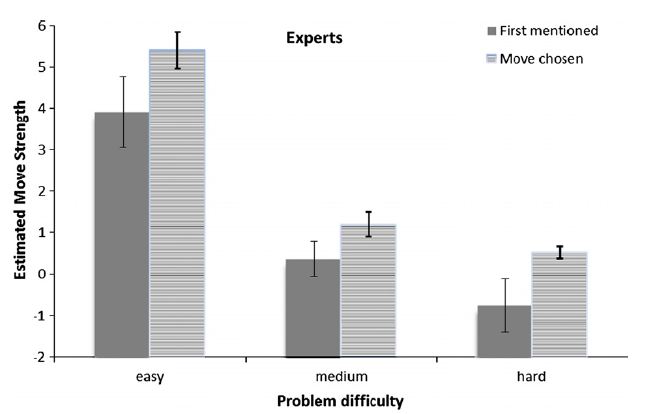
This pattern--improved moves with more deliberation--was also observed in less expert players, but that finding is not terribly surprising. Expertise is thought to be the basis of intuition, so we expect that rapid intuitions of less expert players will not be as good, and that they will benefit from slower, deliberative processes.
More surprising is that experts showed the same benefit. Other studies (e.g., Burns, 2004) using a different methodology drew a different conclusion. For example, when playing speeded chess (which allows very little time for each move) the differences between good, very good, and expert players remains largely intact. So whatever it is that makes the best players the best, it can't be slow, deliberative processes, because there's no time for these processes to operate in speeded chess. It's been thought that the rapid, intuitive processes are due to pattern recognition of game positions.
Moxley et. al argue that the difference between their results and previous ones may lie in the fact that they examined move selection whereas Burns (and other researchers) have examined the outcome of entire games.
In the final analysis, the most apt conclusion seems to be that both pattern recognition and deliberative cognition are major contributors to expertise.
Burns, B. D. (2004). The effects of speed on skilled chess performance.
Psychological Science, 15, 442–447.
Moxley, J. H., Ericsson, K. A., Charness, N., & Krampe, R. T. (2012). The role of intuition and deliberative thinking in experts' superior tactical decision-making. Cognition, 124, 72-78.
More surprising is that experts showed the same benefit. Other studies (e.g., Burns, 2004) using a different methodology drew a different conclusion. For example, when playing speeded chess (which allows very little time for each move) the differences between good, very good, and expert players remains largely intact. So whatever it is that makes the best players the best, it can't be slow, deliberative processes, because there's no time for these processes to operate in speeded chess. It's been thought that the rapid, intuitive processes are due to pattern recognition of game positions.
Moxley et. al argue that the difference between their results and previous ones may lie in the fact that they examined move selection whereas Burns (and other researchers) have examined the outcome of entire games.
In the final analysis, the most apt conclusion seems to be that both pattern recognition and deliberative cognition are major contributors to expertise.
Burns, B. D. (2004). The effects of speed on skilled chess performance.
Psychological Science, 15, 442–447.
Moxley, J. H., Ericsson, K. A., Charness, N., & Krampe, R. T. (2012). The role of intuition and deliberative thinking in experts' superior tactical decision-making. Cognition, 124, 72-78.
 RSS Feed