Someone needs to tell Glen Whitney that algebra doesn't matter.
Poor, deluded Whitney has seen the negative attitude that most Americans have about mathematics--it's boring, it's confusing, it's unrelated to everyday life--and concluded that Americans need a mathematical awakening.
To prompt it, he's spearheading the creation of a Math Museum in New York City, the only one of its kind in North America. (There had been a small math museum on Long Island, the Goudreau Museum. It closed in 2006).
Whitney reports that he loved math in high school and college, but didn't think he was likely to make it as a pure researcher. He went to work for a hedge fund, creating statistical models for trading. When the Goudreau Museum closed, he organized a group to explore opening a math museum that would be more ambitious.
A rendering of the plan is shown below.
Poor, deluded Whitney has seen the negative attitude that most Americans have about mathematics--it's boring, it's confusing, it's unrelated to everyday life--and concluded that Americans need a mathematical awakening.
To prompt it, he's spearheading the creation of a Math Museum in New York City, the only one of its kind in North America. (There had been a small math museum on Long Island, the Goudreau Museum. It closed in 2006).
Whitney reports that he loved math in high school and college, but didn't think he was likely to make it as a pure researcher. He went to work for a hedge fund, creating statistical models for trading. When the Goudreau Museum closed, he organized a group to explore opening a math museum that would be more ambitious.
A rendering of the plan is shown below.
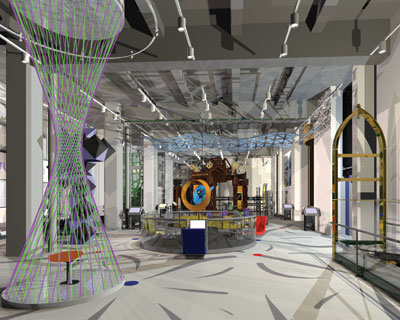
The plan is for exhibits similar to those seen in science museums--plenty of interaction and movement on the part of visitors, and a focus on the fact that mathematics is all around us.
All around us to the point that Whitney currently gives math walking tours in New York City. As he notes in a recent interview in Nature, math is in "the algorithms used to control traffic lights, the mathematical issues involved in keeping the subway running, the symmetry of the mouldings on the sides of buildings and the unusual geometry that gives gingko trees their distinctive shape."
A traveling exhibition, Math Midway, has been making the rounds of science museums around the country, whetting appetites for the the grand opening (December 15th, 2012).
The most popular exhibit is a tricycle with square wheels which can be ridden smoothly on a track with inverted curves, calculated to keep the axles of the trike level. In the photo below it's ridden by Joel Klein (former New York chancellor of education and current leader of News Corporation's education venture).
All around us to the point that Whitney currently gives math walking tours in New York City. As he notes in a recent interview in Nature, math is in "the algorithms used to control traffic lights, the mathematical issues involved in keeping the subway running, the symmetry of the mouldings on the sides of buildings and the unusual geometry that gives gingko trees their distinctive shape."
A traveling exhibition, Math Midway, has been making the rounds of science museums around the country, whetting appetites for the the grand opening (December 15th, 2012).
The most popular exhibit is a tricycle with square wheels which can be ridden smoothly on a track with inverted curves, calculated to keep the axles of the trike level. In the photo below it's ridden by Joel Klein (former New York chancellor of education and current leader of News Corporation's education venture).
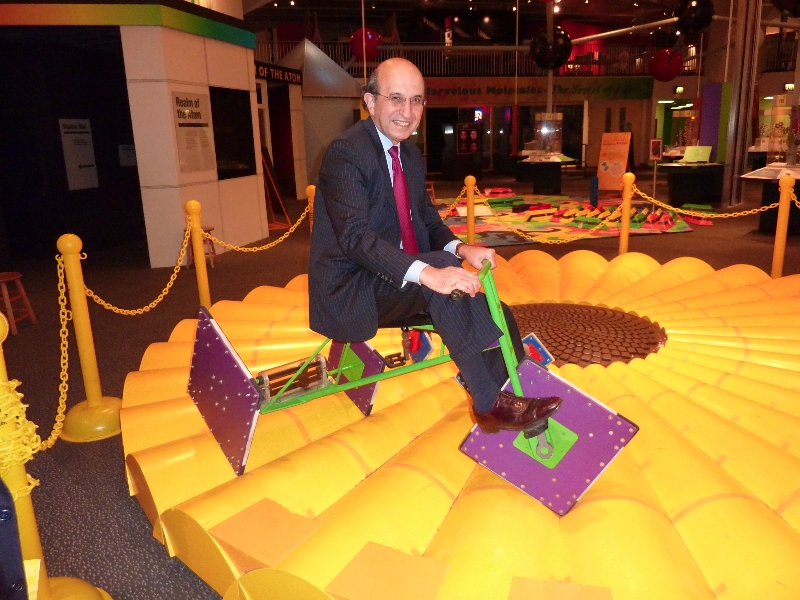
Whitney says that the beauty of the tricycle exhibit is that it gives people the sense that math can make the impossible seem possible.
Next impossible challenge: persuade people who think that math is mostly irrelevant and should be dropped from public schooling for most kids that they are wrong.
The Math Museum looks like a long step toward making that goal seem possible.
More at MoMath.org.
Next impossible challenge: persuade people who think that math is mostly irrelevant and should be dropped from public schooling for most kids that they are wrong.
The Math Museum looks like a long step toward making that goal seem possible.
More at MoMath.org.
 RSS Feed