Illiteracy and its costs to individuals and to society has long been a focus of concern in public policy. A corresponding lack of ability in mathematics--innumeracy--has received increasing attention in the last few decades. The ability to use basic math is more and more important as modern day society grows more complex.
Some children have a problem in learning to read that is disproportionate to any other academic challenge they face. Some children have a corresponding problem with math. For some reason, the ideas just don't come together for these students.
In a recent article, David Geary (2013) reviews evidence that one cause of the problem may be a fundamental deficit in the representation of numerosity.
Geary describes three possible sources of a problem in children's appreciation of number.
To appreciate where the problems may lie, you need to know about the approximate number system. All children (and members of many other species) are born with an ability to appreciate numerosity. The approximate number system does not support precise counting, but allows for comparison judgements of "more than" or "less than." For example, in the figure below you can tell at a glance (and without counting) which cloud contains more dots.
Some children have a problem in learning to read that is disproportionate to any other academic challenge they face. Some children have a corresponding problem with math. For some reason, the ideas just don't come together for these students.
In a recent article, David Geary (2013) reviews evidence that one cause of the problem may be a fundamental deficit in the representation of numerosity.
Geary describes three possible sources of a problem in children's appreciation of number.
To appreciate where the problems may lie, you need to know about the approximate number system. All children (and members of many other species) are born with an ability to appreciate numerosity. The approximate number system does not support precise counting, but allows for comparison judgements of "more than" or "less than." For example, in the figure below you can tell at a glance (and without counting) which cloud contains more dots.
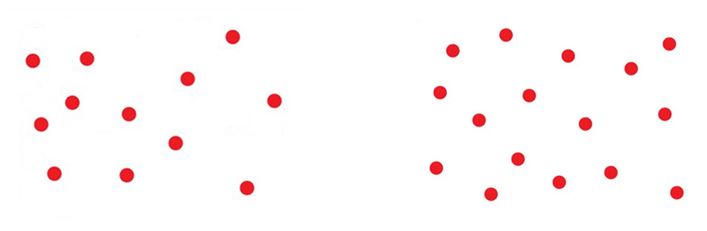
This ability --making the comparison without counting--is supported by the approximate number system. (Formal experiments control for things like the total amount of "dot material" in each field, and so on.)
The ability depends on not on the absolute difference in number of dots, but on the ratio. Adults can discriminate ratios as low as 11:10. Infants can perform this task, but the ratio of the difference in dots must be much greater, closer to 2:1.
Many researchers believe that this approximate number system is the scaffold for an understanding of the cardinal values of number.
So the first possible source of problems in mathematics may be that the approximate number system does not develop at a typical pace, leaving the child slow to develop the cognitive representations of quantity that can support mathematics.
A second possibility is that the approximate number system works just find, but the problem lies in associating symbols (number names and arabic numerals) to the quantities represented there. Geary speculates that regulating attention may be particularly important to this ability.
Finally, It is possible for children to appreciate the cardinal value of numbers and yet not understand the logical relationships among those numbers, to appreciate the structure as a whole. That's the the third possible problem.
Geary suggests that there is at least suggestive evidence that each of these potential problems creates trouble for some students.
The analogy to dyslexia is irresistible, and not inappropriate. Math, like reading, is not a "natural" human activity. It is a cultural contrivance, and the cognitive apparatus to support it must be hijacked from mental systems meant to support other activities.
As such, it is fragile, meaning it lacks redundancy. If something goes wrong, the system as a whole functions very poorly. Thus, understanding how things might go wrong is essential to helping children who struggle early on.
Gear, D. (2013) Early foundations for mathematics learning and their relations to learning disabilities. Current Directions in Psychological Science, 22, 23-27.
The ability depends on not on the absolute difference in number of dots, but on the ratio. Adults can discriminate ratios as low as 11:10. Infants can perform this task, but the ratio of the difference in dots must be much greater, closer to 2:1.
Many researchers believe that this approximate number system is the scaffold for an understanding of the cardinal values of number.
So the first possible source of problems in mathematics may be that the approximate number system does not develop at a typical pace, leaving the child slow to develop the cognitive representations of quantity that can support mathematics.
A second possibility is that the approximate number system works just find, but the problem lies in associating symbols (number names and arabic numerals) to the quantities represented there. Geary speculates that regulating attention may be particularly important to this ability.
Finally, It is possible for children to appreciate the cardinal value of numbers and yet not understand the logical relationships among those numbers, to appreciate the structure as a whole. That's the the third possible problem.
Geary suggests that there is at least suggestive evidence that each of these potential problems creates trouble for some students.
The analogy to dyslexia is irresistible, and not inappropriate. Math, like reading, is not a "natural" human activity. It is a cultural contrivance, and the cognitive apparatus to support it must be hijacked from mental systems meant to support other activities.
As such, it is fragile, meaning it lacks redundancy. If something goes wrong, the system as a whole functions very poorly. Thus, understanding how things might go wrong is essential to helping children who struggle early on.
Gear, D. (2013) Early foundations for mathematics learning and their relations to learning disabilities. Current Directions in Psychological Science, 22, 23-27.
 RSS Feed