I was just at a reading conference and gave a talk on reading comprehension strategies.

I’ve written about them before (article here). The next paragraph provides just a brief summary of what I’ve written. The figure below shows the strategies themselves, if you’re not familiar with them (click the image for a larger version).

The short version of my conclusion is that they don’t really improve the comprehension process per se. Rather, they help kids who have become good decoders to realize that the point of reading is communication. And that if they can successfully say written words aloud but cannot understand what they’ve read, that’s a problem. Evidence for this point of view include data that kids don’t benefit much from reading comprehension instruction after 7th grade, likely because they’ve all drawn this conclusion, and that increased practice with reading comprehension strategies doesn’t bring any improved benefit. It’s a one-time increment.
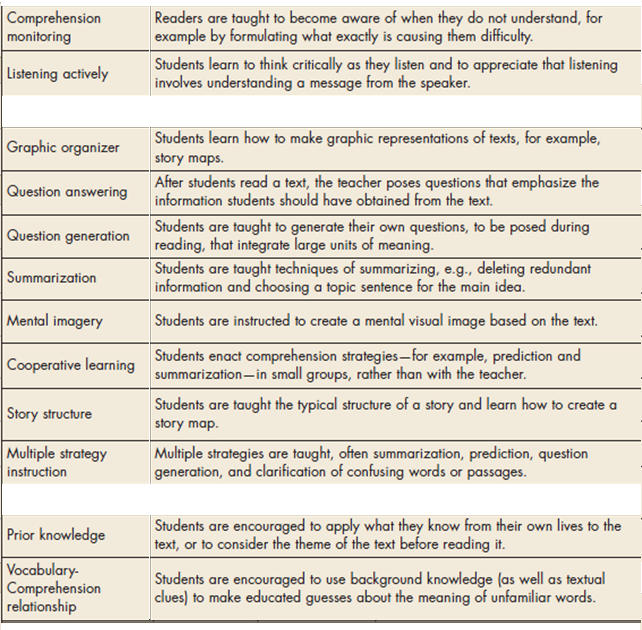
How much time is devoted to reading comprehension strategy instruction? I can’t find good (or poor) data on this question, and I doubt it exists. There is so much variation among districts (and probably even classrooms) on this issue, it’s hard to draw a conclusion with much confidence. Any time I talk about reading, a lot of teachers, coaches, and administrators tell me that enormous amounts of time go to reading comprehension strategy instruction in their district—but I’m sure the people who make sure to mention this to me are not a random sample. 

Whatever the proportion of time, much of it is wasted, at least if educators think it’s improving comprehension, because the one-time boost to comprehension can be had for perhaps five or ten sessions of 20 or 30 minutes each.

Some reading comprehension strategies might be useful for other reasons. For example, a teacher might want her class create a graphic organizer as a way of understanding how an author builds narrative arc

The wasted time obviously represents a significant opportunity cost. But has anyone ever considered that implementing these strategies make reading REALLY BORING? Everyone agrees that one of our long-term goals in reading instruction is to get kids to love reading. We hope that more kids will spend more time reading and less time playing video games, watching TV, etc.

How can you get lost in a narrative world if you think you’re supposed to be posing questions to yourself all the time? How can a child get really absorbed in a book about ants or meteorology if she thinks that reading means pausing every now and then to anticipate what will happen next, or to question the author’s purpose?

To me, reading comprehension strategies seem to take a process that could bring joy, and turn it into work.


Comments

Erich Martel
05/01/2012 12:30am

Wow, Half of this stuff is in DCPS's Teaching and Learning Framework, which is partner of the IMPACT teacher evaluation instrument, i.e. activities that teachers are expected to have the students do in class every day.

Good thing the creators didn't see the chart; otherwise all of those items would have been included

Layla Sacker
05/01/2012 6:09am

HI Daniel, much to think about in this blog. I agree that teaching comprehension as an end in itself can destroy appreciation of a great story. BUT when you teach comprehnsion it has to be based on careful observation of the reader. I have often noticed in struggling readers that they don't have many strategies that they can call on consciously. So teach them at point of need... not as a lesson plan to tick off a comprhension strategy.

Jason
05/01/2012 7:33am

Interesting points about reading comprehension Dr.Willingham. I think you're making the point that teaching kids to deeply analyze text by asking questions about it gives little to no benefit and that doing so removes the joy from reading.

I don't understand what you mean about students not getting any benefit from being taught decoding strategies after 7th grade. I teach in a school that has a high proportion of ELL students past grade 10. Is teaching them decoding text not something I should be teaching them?

Is the list of strategies what you mean by teaching reading comprehension? I find these very useful (or thought I did) in teaching high school science. Summarizing, active reading by asking questions and having students try to figure out the meaning of words in context are things I thought were useful. Data says otherwise?

05/01/2012 11:56am

@Jason--I don't mean to say that teaching kids to deeply analyzing text by asking questions about it gives little to know benefit." To me, deep analysis implies that shallow analysis--you can give some account of what the text means--is more or less in place. The effectiveness of reading comprehension strategies are usually assessed by reading tests, which typically don't probe very deeply. They measure whether or not you got the gist. It's by that metric that the research shows they "work" and it's by that metric that I claim "yes, they work, but it's a one-time boost and the benefit is inconsistent or absent for younger kids and older kids."

I agree that the activities listed as reading comprehension strategies might be useful as ways of probing deeper into a text. That's what I meant when I said a teacher might think it a good idea to use a graphic organizer to understand narrative arcs. There's no research base for this as far as I know--I'm just saying a teacher may think its effective (and it sure sound reasonable to me).

Jason
05/02/2012 7:10am

Thanks for the reply Dr.Willingham. I missed the points about the limited measures of effectiveness. It makes sense now.
Data on effectiveness of the strategies in the figure you posted on reading comprehension would be interesting.

05/01/2012 1:31pm

I don't think you answered the question that Jason which is, are these strategies useful for sub-groups like ELs. I've recently moved from teaching in a high EL to almost no EL environment. I use fewer of these strategies than I have in the past just because they don't need them.

Also, can you clarify, in the post you say there is not much benefit for students after 7th grade, but in this response, you say the benefit is inconsistent or absent for younger kids and older kids. Is there any benefit in primary student (under 9), or upper elementary (under 12)

05/03/2012 11:30am

Alice, I think up el is where you most consistently see a good boost: grades 3, 4, 5 and perhaps 6; you see a positive effect in almost every study. In lower or higher grades "inconsistent" is probably the most accurate characterization--you see an effect in some studies, but in many you do not. So one interpretation is that comprehension strategy instruction is implemented inconsistently, and kids in those grades need it to be implemented in just the right way--in other words, you could say " I still think that comprehension strategies are a good idea in those grades, so let's figure out why they work less consistently there." I'm suggesting that the inconsistency is in line with the interpretation I'm offering. At lower grades comprehension strategies don't work because kids working memory is pretty well full with the task of decoding, so most can't take advantage of the strategies. For older kids, I'm arguing that most of the boost comes from recognizing that the *function* of reading is communication--a recognition that most kids will have come to, one way or another, by 7th grade.

05/01/2012 2:48pm

I'm glad Dan is paying attention to exactly how the research defines "effectiveness." But even more important is his other point: Does this kind of teaching turn kids off to reading over the long term? Any research that doesn't factor that question into its definition of "effectiveness" is meaningless.

Extended rant <a href="http://ablogaboutschool.blogspot.com/2012/04/educational-thalidomide-or-whats-wrong.html">here</a>.

05/01/2012 3:21pm

Sorry, the HTML link didn't work. Link here:

http://ablogaboutschool.blogspot.com/2012/04/educational-thalidomide-or-whats-wrong.html

The idea that "effectiveness" equals "raising short-term test scores, without regard to any other effects" is now so thoroughly ensconced that questioning it is like playing Whack-a-Mole.

Jackie Knapp
05/08/2012 12:51pm

I developed my own strategy as a part of my approach to teaching science. I found that students in my 7th and 8th grade classes had learned to 'read' words and could do so, but also the information simply went in and made no cognitive impression whatsoever. They could also appear to be listening while thinking about something totally at odds with my class presentation. So I devised an exercise that got all the students involved. And it became a worthwhile part of my approach, teaching reading/thinking/learning/test taking as an integrated approach which could apply to science as well as other classes.
This is how I did it. I picked a page from the science text and asked for a volunteer to read a paragraph aloud. You'll get lots of volunteers, but some won't volunteer and it's important not to select them for this exercise. They'll be the ones you talk to privately later to see if they can, in fact, read. I didn't want to humiliate them.
As soon as the selected student finishes reading the paragraph and looks up, I would then say "Stop! Now look at me." Lots of puzzled looks the first time. I would then direct the reader to cover the paragraph he/she had just read with their hands, and then ask them to explain what they had just read. Astonishingly, most of them could not.
I would then select another volunteer to repeat the exercise with a different paragraph. After three or more of these, the students could tell you what they'd read. The next step after once again telling them to stop was to select a student (usually from the ones who gravitate toward the back of the classroom for their seating choice) and ask HIM what the reader had just read. Again, the first two or three couldn't tell me. But by the time I finished one class, about an hour in duration, they were reading, able to restate what the paragraph was about, and able to discuss what had been read aloud. The lesson got reinforcement later in the form of 10-minute review activities that I could use to get a class off to a good start.

Brian
05/08/2012 2:55pm

Thanks - interesting research and conclusion. What about complex reading material, such as Shakespeare, etc. in which there is a great deal of abstract references and symbology? As part of my college literature courses, I found myself 'learning' to think differently - more thoroughly and from different perspectives - about what I was reading because I was much more mature and mentally developed than I was as 7th grader....I would be astonished if, had any measurements taken place, that my comprehension level would have been the same to two very different points in my life.

Lessa Scherrer
05/08/2012 9:06pm

I think you commenters are missing an important part of this article: reading comprehension is an either-you-have-it-or-you-don't skill. Those students who don't have it--no matter how old--still need to attain it. Those student who have mastered it (realized that the point of reading is communication) do not need additional reading comprehension teaching. There comes a time when students no longer need to do a "picture walk" through every story they begin. Indeed, eventually there will be no pictures to walk through. Similarly, there will come a time when students should be allowed to read a novel (at their reading level) without having to stop and write a summary and prediction of each chapter as they go. This usually happens around the time they can remember their questions through the whole reading session because they're not using so much brain to decode. Texts which are challenging for the students' reading level will always need additional comprehension strategies. But the determination of whether comprehension needs to be taught should be made on a case-by-case, child-by-child basis, otherwise we risk turning kids off of reading.`

05/08/2012 9:27pm

I have a very high IQ but, I am a usually very slow reader. Usually I read every word. When I am familiar with a subject or an author, which is rare, I can read at 2000 wpm. Most of the time it is around 200 wpm. Now that I am getting older it can be much less.
From my POV, reading speed and comprehension are about hypothesis formation; anticipating what the author is about to say, then confirming or adjusting ones thoughts when guesses are not confirmed.
It seems to me that most of your work is about getting students to engage with unfamiliar and perhaps unpalatable subjects, then measuring your progress in engaging them.
I suspect that if you worked on reading comprehension using sources like People Magazine, The Star, or The National Enquirer, your results would be quite different.

05/09/2012 2:56am

These findings would be really helpful when I was still studying. I find this very true and I think if we can provide the proper solution or cater the students needs we can assure students learning.

05/10/2012 3:21am

You know one think video game is the best pain relief of your mind.

Dan Lucas (blendedschools.net)
05/10/2012 9:13am

Would you be able to provide the citation for the research about reading strategies not being helpful after 7th grade? Very interested in this topic. Thanks.

Dan Willingham
05/10/2012 1:03pm

Dan--several people have asked me about this. I will do a full blog post about it when I can get to it.

Brian
05/10/2012 2:53pm

Cathy
05/15/2012 9:59pm

Interesting discussion. …I teach upper elementary reading. I am disappointed at the degree with which teachers over teach the use of strategies. The strategies themselves have become the end rather than the means. Hard working, devoted teachers devise and purchase “games” with names like ‘the monitor and clarify game’, or- my favorite- ‘prediction bingo’. There is an entire industry created around this stuff—workshops, books, activities. Kids are tested several times per year over these skills; yet they never take a test over the content of a novel or short story. The tests themselves have titles like ‘text features assessment for learning’ or ‘author’s purpose common assessment.’’ Imagine you are a fifth grader and as you are handed your graded quiz you are told that your predictions are wrong because they are not based on details from the text. Perhaps you’ve lost some points because the answers you wrote didn’t include your schema as stated in the question. Sadly, some of our best readers are baffled by this stuff and would just like to discuss the ‘story’. Often these short-sighted tests discourage creative answers or outside-of- the- box thinking. Frankly, I’d rather put great literature in their hands, allow them to read it, act it, wonder about it, draw it—anything rather than kill it with this mind-numbing nonsense. But, alas—I’ll hit the hallway early tomorrow morning and kindly shrug my shoulders when my well intentioned fellow teacher asks me if I’ve seen the Jumbo Inferenceing Concentration Card Game.

05/16/2012 4:03am

Cathy: Your comment is extremely interesting. It sounds like teachers in your environment are trying very hard using the latest methodologies.
I don't believe that there is one strategy that is best for all students.
Do you feel that these methods do not work for any students, or that they are generally marginal in their success?

05/16/2012 4:04am

Cathy: Your comment is extremely interesting. It sounds like teachers in your environment are trying very hard using the latest methodologies.
I don't believe that there is one strategy that is best for all students.
Do you feel that these methods do not work for any students, or that they are generally marginal in their success?

05/16/2012 4:04am

Cathy: Your comment is extremely interesting. It sounds like teachers in your environment are trying very hard using the latest methodologies.
I don't believe that there is one strategy that is best for all students.
Do you feel that these methods do not work for any students, or that they are generally marginal in their success?

05/30/2012 6:10am

this comment shows the external effects of whole persons with her enjoyment and effective process also possible to transfer the creative ideas.

06/01/2012 2:12am

The reading may increase the capacity of communication and their knowledge .

07/30/2012 1:41pm

While reading your blog, it seems that you research on this topic very much. I must tell you that your blog is very informative and it helps other also.

09/03/2012 2:10am

This is what I have been searching in many websites and I finally found it here. Amazing article. I am so impressed. Could never think of such a thing is possible with it.

shrug my shoulders when my well intentioned fellow teacher asks me if I’ve seen the Jumbo Inferenceing Concentration Card Game.

09/16/2012 6:48am

Summarizing, active reading by asking questions and having students try to figure out the meaning of words in context are things I thought were useful. Data says otherwise?

Dan Willingham
09/17/2012 4:30am

No, it's not that those are not useful to students' cogntion. The question is how much practice/instruction they need in these skills; the point is that they learn them pretty quickly, and continuing to practice them doesn't seem to add much benefit.

09/17/2012 11:24am

they help kids who have become good decoders to realize that the point of reading is communication.

Thanks for informative post. <a href="http://www.wondershare.com/pdf/top-5-free-adobe-acrobat-alternatives.html">alternatives to Adobe Acrobat for Mac</a>

09/21/2012 3:06pm

as an incentive to theaters to keep movies in the theater longer.


Comments are closed.